Spray nozzles & systems
What type of liquid is used in the spray process?
A liquid's specific gravity, viscosity and the presence of particles affect the spray characteristics of the nozzle.
Specific gravity (density)
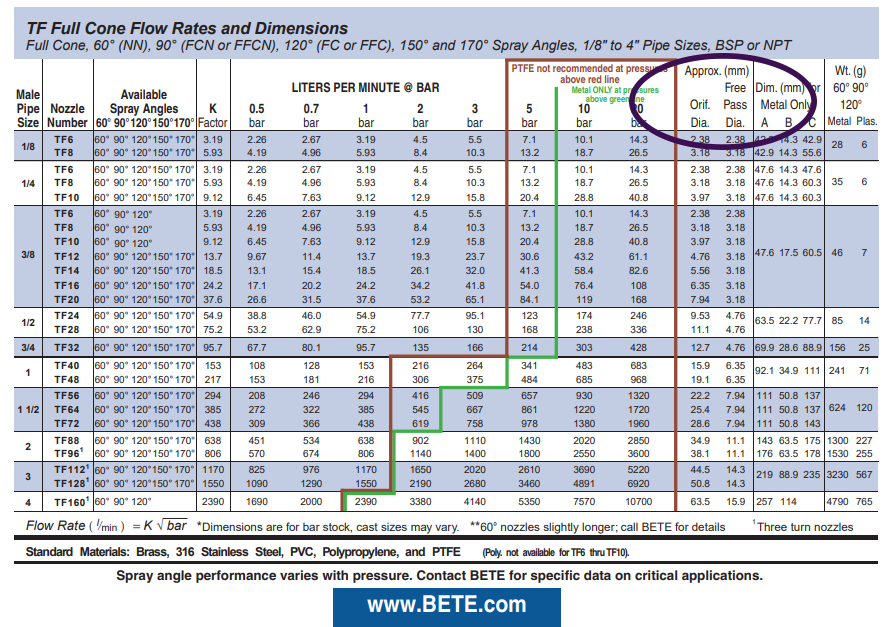
The spray nozzle data sheet lists the flow rate at specific gravity (SG) = 1, i.e. water. Liquids with a higher specific gravity than water create a lower flow rate and liquids with a lower specific gravity than water create a higher flow rate than stated in the data sheet. The following relationship applies between the flow rates (Q) for liquids with different specific gravities:
Q2/Q1 = √(SG1/SG2)
Viscosity
High viscosity inhibits the atomisation of the droplets in the spray. In general, fluids with viscosities greater than 100cP are difficult to atomise. To get a good result, air atomising nozzles are used, mixing liquid with compressed air, which creates a spray consisting of small droplets.
| Liquid properties @ room temperature | |||||||||||
|---|---|---|---|---|---|---|---|---|---|---|---|
| Liquid | Viscosity | Specific weight | |||||||||
| Water | 1 cP | 1 SG | |||||||||
| Oil 10W-30 | 110 cP | 0.88 SG | |||||||||
| Honey | 1500 cP | 1.05 SG | |||||||||
Particles
If there are particles in the liquid and if the particle size is larger than the free passage of the spray nozzle, there is a risk of the nozzle clogging. The spray nozzle data sheet shows the free passage of the nozzle in millimetres.
Particles in the liquid increase the risk of wear and tear, shortening the spray nozzle lifespan. Wear can be limited by choosing a more durable material or using a suitable filter.