


Column internals
How does stripping work? Key process parameters?
Stripping is a mass transfer process where one or more substances are removed from a liquid. One of our areas of expertise in mass and heat transfer is the removal of ammonium or other volatile substances and contaminants in process or waste water.
Example - Ammonia stripping
Process water and wastewater from industries, biogas plants and municipal treatment plants contain ammonium ions (NH4+) and ammonia gas (NH3), which has a negative impact on water quality, ecosystems and human health. Stripping with air or steam is a safe and cost-effective process to easily remove contaminants.
Process and wastewater contain ammonium ions together with dissolved ammonia gas:
NH4+ + OH– ↔ NH3 + H2O
- pH <7 ⇒ virtually all ammonia will be soluble ammonium ions (NH4+)
- pH >12 ⇒ virtually all ammonia will be dissolved gas (NH3)
- in the pH7 to pH12 range, both NH4+ and NH3 are present in the process water or wastewater
- the amount of dissolved gas (NH3) increases with temperature and pH
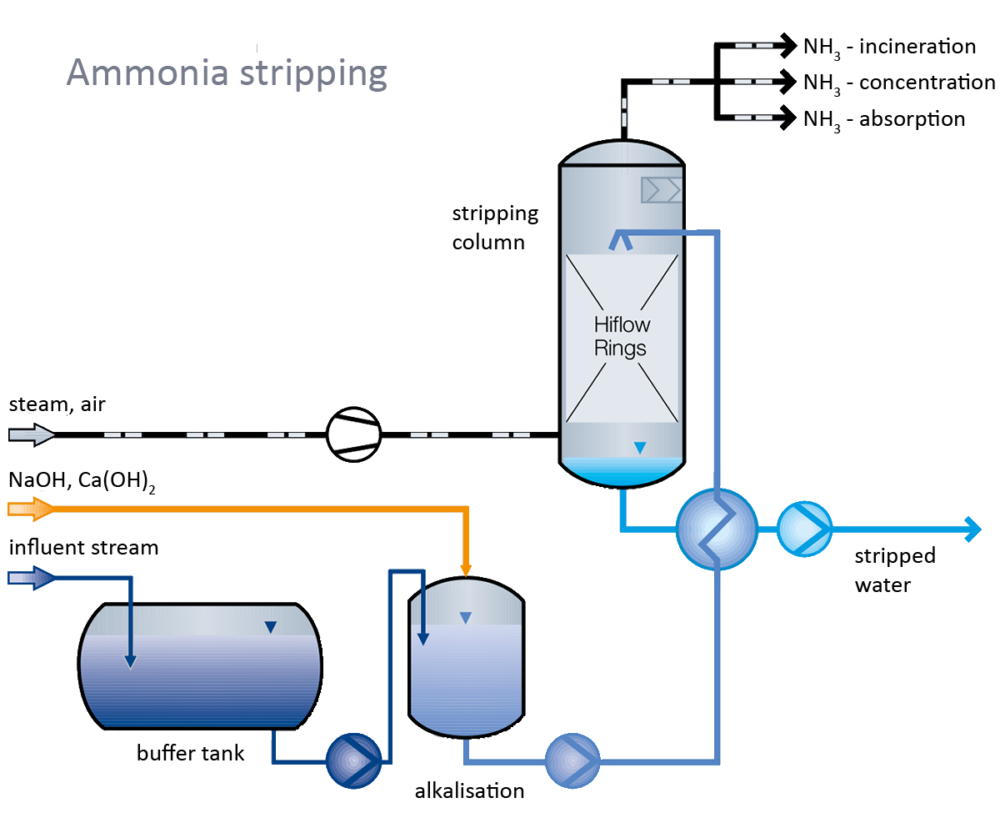
The process of removing ammonium ions and dissolved ammonia gas from wastewater is achieved in a packed column, where the function of the packed bed is to increase the liquid-gas contact area. Before introducing the contaminated water into the column, the temperature is adjusted and the pH is raised (by adding NaOH or lime) to increase the proportion of NH3 in the process water or wastewater.
The influent stream is introduced at the top of the packed bed and flows down through the column. Countercurrent to this, air or steam flows up and strips ammonia from the liquid phase. Ammonia-laden off-gases exit the top of the column and treated water is collected in the column sump.
Which process parameters are important when designing a stripper column?
The following parameters are important to consider when deciding whether ammonia stripping should be carried out using air or steam:
- Process-specific conditions
- Wastewater temperature
- Amount and type of pollutant
- Energy source
- Is it possible to re-use removed contaminants? Commercial value?
- Do the off-gases need to be treated in order to reduce emission?