Spray nozzles & systems
Desired flow rate? Available pressure?
Desired volume flow depends on the specific spray process. Most spray processes have general rules of thumb for flow ranges, but in many cases on-site testing is needed to achieve the right results.
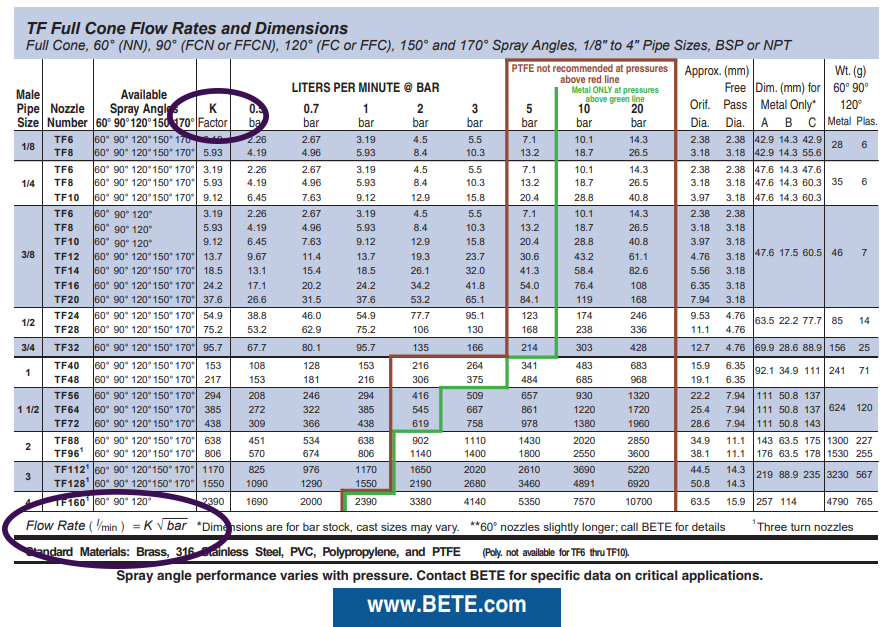
The flow of a specific nozzle depends on its size and pressure. The volume of liquid flowing through the nozzle depends mainly on the difference between the pressure at the nozzle's outlet and the pressure surrounding the nozzle where it sprays, which is usually atmospheric pressure.
If the specific pressure is not listed in the nozzle data sheet, it is possible to calculate the nozzle flow at a given pressure by using the equation at the bottom of the data sheet. The K-factor can be found in the table in the data sheet.
When spraying in a vessel where the pressure is not atmospheric, the differential pressure is calculated by subtracting the pressure in the vessel from the pressure at the nozzle inlet: l/min = K(Bar, inlet - Bar, vessel)^x.